6-7 DAYS | KILIMANJARO CLIMBRongai Route
Kilimanjaro’s northern approach — drier, quieter, and genuinely different
DURATION6 or 7 Days
|
DISTANCE~65 km / 40 mi
|
ACCOMMODATIONMountain Tents
|
DIFFICULTYModerate
|
SUMMIT SUCCESS~80-85%
6-DAY CLIMB FROM$2,170 pp
Group of 6 climbers
|
7-DAY CLIMB FROM$2,472 pp
Group of 6 climbers
|
Mountain Huts
PRE/POST-CLIMB HOTELStandard · Select · Premium
Arusha or Moshi
|
BEST PAIRED WITH
Northern Highlights, Zanzibar
Post-climb safari is the most requested
[ OVERVIEW ]
The quiet side of the mountain
Rongai is the only route that approaches Kilimanjaro from the north, starting near the Kenyan border rather than from Moshi's more-travelled southern gates. Because this side of the mountain sits in a rain shadow, it stays noticeably drier even during the shoulder-season months when the southern routes see more rain — a genuine practical advantage if your travel dates aren't fully flexible.
The trade-off shows up in the numbers: Rongai's summit success rate runs somewhat lower than Machame or Lemosho, since the ascent profile is more direct and offers less built-in acclimatization time by default. We only recommend the 6-day version to climbers with prior high-altitude experience or a demonstrated fast acclimatizer's history — for nearly everyone else, the 7th day is the better call. The route also has a distinctive shape: climbers ascend the quiet north side, then descend via the Marangu route on the south side, meaning you genuinely see two different faces of the mountain in one trip.
Ascend the north side, descend via Marangu
Driest route — good for rainy-season timing
Among the quietest camps on the mountain
Camping on the ascent, tented near Horombo on descent
KPAP-aligned porter practices
RONGAI IS A STRONG FIT IF
Your travel dates fall in the shoulder or rainy season
Quiet, uncrowded camps matter more to you than the highest possible success rate
You'd like to see both the northern and southern sides of the mountain in one climb
You're booking the 7-day version, or have prior high-altitude experience
CONSIDER ANOTHER ROUTE IF
Maximizing your summit odds is the single top priority — Lemosho or Machame rank higher
You'd strongly prefer a hut every night — look at Marangu
You want the Barranco Wall experience specifically — that's Machame or Lemosho
The extra drive time to the remote Rongai Gate doesn't suit your schedule
Not sure Rongai is right for you? Tell us your timeframe, budget, and trekking experience and we can recommend a route that fits — even if that means pointing you to Machame or Lemosho instead.
|
[ RONGAI VS. MARANGU ]
The shorter-season-friendly routes compared
Rongai and Marangu are often the two routes climbers weigh against each other when they need more scheduling flexibility or want a gentler introduction to the mountain. Here's a snapshot of the key difference.
ROUTE
Rongai
Lemosho
ACCOMMODATION
Tents
Tents
6-7
DAYS
7-8
~80-85%
APPROX. SUCCESS RATE
~90-95%
Low-Medium
CROWD LEVEL
Low-Medium
Drier northern side; quieter than Machame
BEST FOR
Highest success odds; remote, scenic
Success rate ranges are general estimates and can vary by operator, itinerary length, season, and individual fitness.
Comparing all the Kilimanjaro routes? See our full route comparison on the Kilimanjaro overview page.
[ ITINERARY ]
Seven days, the mountain’s other side
Shown here is the 7-day itinerary, that we recommend for most climbers. The 6-day version follows the same route, simply without the second night at Mawenzi Tarn Camp.
DAY 1
Rongai Gate → Simba Camp
1,996 M → 2,650 M · 7 KM · 3-4 HOURS ·MONTANE RAINFOREST
A long drive from Moshi or Arusha around to the mountain's remote north side brings you to Rongai Gate, close to the Kenyan border. The walk in is gentle, through quiet pine forest that sees a fraction of the traffic on the southern approaches, with good early chances of spotting colobus monkeys.
Pine and cedar forest · Occasional views into Kenya
DAY 2
Simba Camp → Kikelewa Camp
2,650 M → 3,679 M · 11 KM · 5-6 HOURS · MOORLAND
The trail climbs out of the forest onto open moorland, with the jagged spires of Mawenzi Peak coming into view ahead — a very different silhouette from Kibo's familiar dome. Camp sits in a sheltered valley, one of the more scenic and least-visited spots on the entire mountain.
First close views of Mawenzi Peak’s jagged ridgeline
DAY 3
ACCLIMATIZATION DAY
Kikelewa Camp → Mawenzi Tarn Camp
3,679 M → 4,330 M · 5 KM · 3-4 HOURS · APLINE DESERT
A short, steep climb leads to Mawenzi Tarn, a small glacial lake camp tucked directly beneath Mawenzi's dramatic rock towers — arguably the most striking camp setting on any Kilimanjaro route. The scenery here rewards the extra effort of choosing the quieter north side.
Mawenzi Tarn beneath Mawenzi’s spires
DAY 4
Mawenzi Tarn Camp
4,330 M · SHORT WALK, SAME CAMP · 2-3 HOURS
A full rest day at Mawenzi Tarn, with an optional short acclimatization walk up toward Mawenzi's lower slopes before returning to camp for the night. This extra day is the main reason the 7-day version's success rate is meaningfully higher than the 6-day's — there's simply no substitute for time spent at altitude before pushing higher.
Close-up views of Mawenzi’s rock formations
DAY 5
Mawenzi Tarn Camp → Kibo Hut Camp
4,330 M → 4,703 M · 9 KM · 4-5 HOURS TOTAL · HIGH ALPINE DESERT
The route crosses "the Saddle," a stark, otherworldly high-altitude plateau between Mawenzi and Kibo, with almost no vegetation at this elevation. This is where Rongai's path joins the same final approach used by Marangu climbers, arriving at Kibo Hut Camp to rest and prepare for summit night.
The Saddle plateau · Kibo’s summit cone up close
DAY 6
Summit Day → Kibo Hut → Gilman’s Point → Uhuru Peak → Horombo Camp
4,703 M → 5,895 M SUMMIT → DESCEND TO 3,720 M · 21 KM · 13-15 HOURS TOTAL
Wake around midnight for a steep, direct scree climb to Gilman's Point on the crater rim — a different final approach from the Barafu-Stella Point line used by Machame and Lemosho, and among the more demanding stretches on the mountain. From Gilman's Point, a further hour or so along the rim reaches Uhuru Peak, typically around sunrise. The long descent continues all the way past Kibo Hut to Horombo, back in the moorland zone on the mountain's south side.
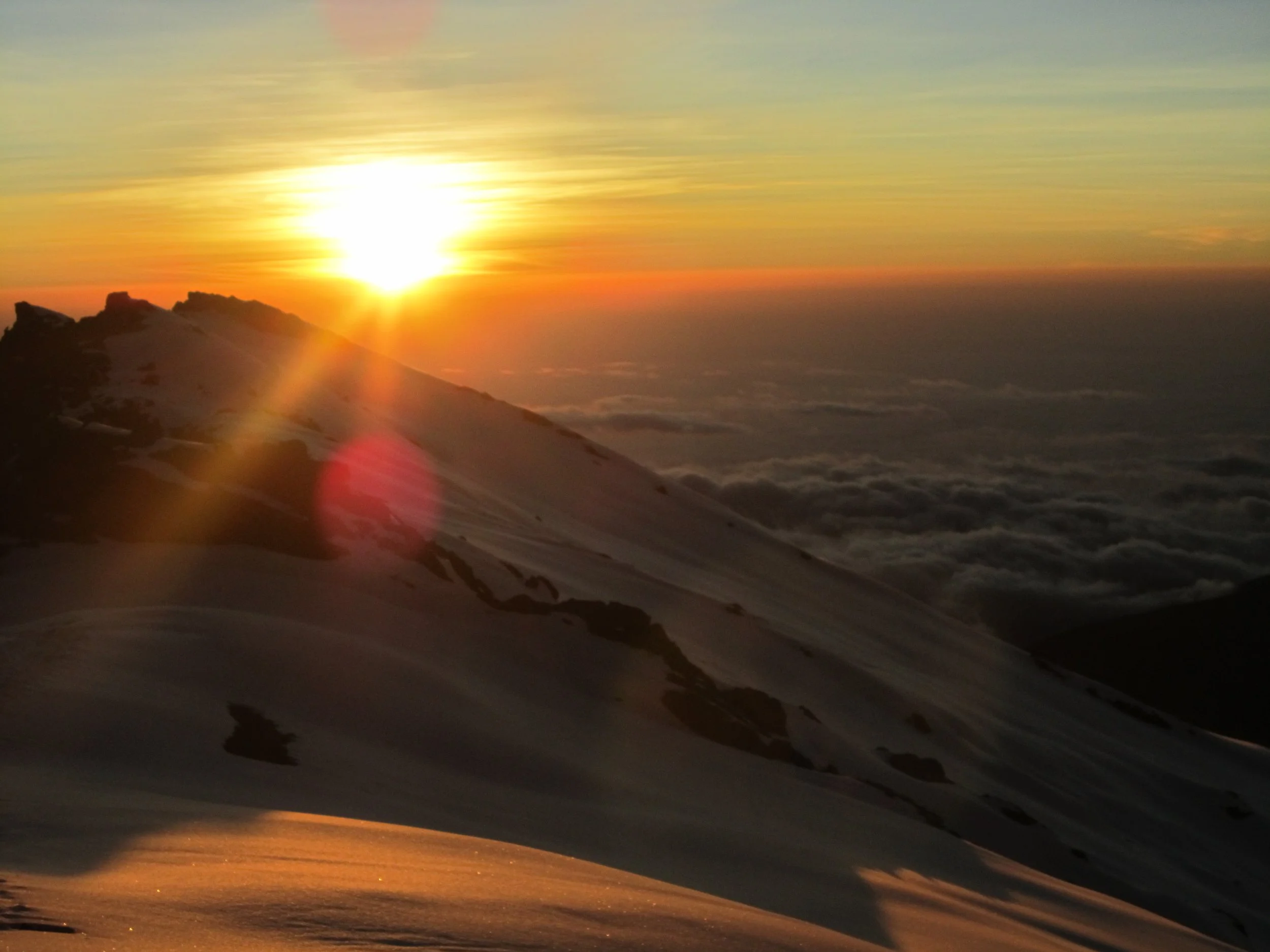
Sunrise from Uhuru Peak · Views over both sides of Kilimanjaro
DAY 7
Horombo Camp → Marangu Gate → Hotel
DESCEND TO 1,860 M · 20 KM · 5-6 HOURS
A long, gradual final descent through moorland and then rainforest to Marangu Gate — meaning your climb both starts and ends on opposite sides of the mountain from each other. Collect your summit certificate at the gate before transferring back to your hotel in Moshi or Arusha.
Summit certificate ceremony at the gate
Booking the 6-day version removes Day 4 entirely — you'll move straight from Mawenzi Tarn to Kibo Hut without the extra rest day. We're glad to run it that way for experienced high-altitude climbers, but we'll always recommend the 7th day first.
|
[ WHAT TO EXPECT ]
What’s actually different about this route
The drier northern side
Because Rongai approaches from the north, it sits in a rain shadow that the southern routes don't benefit from. If your travel dates fall in November or during the shoulder months around the two dry seasons, Rongai holds up noticeably better than Machame, Lemosho, or Marangu — a real, practical reason to choose it beyond scenery or crowd levels.
Ascending one side, descending another
Rongai is unusual in that the descent follows the Marangu route rather than retracing the way up — meaning you'll walk down through Kibo Hut, Horombo, and Marangu Gate on the mountain's south side. It's a genuinely different landscape from the ascent, and one reason climbers describe Rongai as feeling like two routes in one.
Every Misele Kilimanjaro crew follows KPAP-aligned porter welfare standards. Read more about our crews and climbing standards on the Kilimanjaro overview page.
[ PRICING ]
Choose your trek length and comfort level
All prices are per-person estimates in USD and include the climb itself, park and hut fees, crew, and full board on the mountain. Camping equipment is the same across tiers — the difference is your pre- and post-climb hotel standard in Moshi or Arusha.
6-DAY CLIMB · STANDARD HOTEL
From (per person)
$2,170
6 persons traveling together___________________________
1 person $3,540
2 persons $2,724
4 persons $2,261
7-DAY CLIMB · SELECT HOTEL
From (per person)
$2,590
6 persons traveling together___________________________
1 person $4,108
2 persons $3,206
4 persons $2,689
7-DAY CLIMB · LUXURY HOTEL
From (per person)
$2,731
6 persons traveling together___________________________
1 person $4,260
2 persons $3,347
4 persons $2,830
Inclusions & Exclusions
INCLUDED
Kilimanjaro National Park & camping fees
Certified lead guide, assistant guides, cook & porters
Four-season mountain tents & dining tent, all nights
Full board on the mountain (all meals)
Pre- and post-climb hotel night, per selected tier
Airport, Rongai Gate & Marangu Gate transfers
Emergency oxygen & first-aid kit carried by guides
Summit certificate
NOT INCLUDED
International flights
Tanzania entry visa
Travel & high altitude evacuation insurance (required)
Personal climbing gear & cold-weather clothing
Guide, cook & porter gratuities
Sleeping bag & trekking poles (rentable on request)
Prices vary by season and group size. Submit a request for exact figures reflecting your travel dates and group.
[ BEST TIME TO CLIMB ]
The one route where the calendar bends a little
Kilimanjaro's two main dry seasons — January to mid-March, and June through October — apply here too, but Rongai is the one route where the rain shadow genuinely extends your options. Climbers whose only available dates fall in a shoulder month, or who want extra insurance against rain, often choose Rongai specifically for this reason.
|
Traveling in a specific month? See our full Kilimanjaro seasonal guide for month-by-month conditions. Tell us your travel dates and we can advise honestly on what to expect.
[ FAQs ]
Rongai Route FAQs
-
By most operator and park estimates, Rongai's success rate runs around 80% on the 6-day itinerary and roughly 85% on the 7-day version. This sits a little below Machame and noticeably below Lemosho, largely because Rongai's default profile allows for less built-in acclimatization — the extra day at Mawenzi Tarn closes much of that gap.
-
Two honest reasons: weather and crowds. Rongai's northern approach sits in a rain shadow, so it holds up better than the southern routes during shoulder-season or unpredictable-weather periods. It's also among the quietest routes on the mountain, since far fewer operators run it. If your absolute priority is the highest possible success rate, Lemosho or Machame are the better technical choice — Rongai trades a few percentage points of success rate for a genuinely different, quieter experience.
-
Kilimanjaro National Park routes all summit climbers down via established descent paths for logistical and safety reasons, and Rongai's northern trail doesn't have its own separate descent route — climbers instead descend via the same path used by Marangu climbers, through Kibo Hut, Horombo, and Marangu Gate. It's simply how the route is structured, and most climbers enjoy seeing a second side of the mountain as an unexpected bonus.
-
We recommend the 7-day version to nearly everyone. The extra rest day at Mawenzi Tarn Camp is the single biggest factor behind Rongai's improved success rate at that length, and it's a comfortable, low-effort day rather than a difficult one. We'll only suggest the 6-day version for climbers with prior high-altitude experience or a strong track record of acclimatizing quickly.
-
Layered clothing rated for temperatures from mild forest warmth down to well below freezing on summit night, sturdy broken-in hiking boots, a warm four-season sleeping bag (rentable through us), trekking poles, headlamp, and good gloves. Because the drier north side can mean colder, windier camps at altitude, slightly warmer layers than you might pack for Machame are worth considering. We send every confirmed climber a detailed packing list and can arrange rentals in Moshi or Arusha for anything you'd rather not fly with.
-
It's one of our most common requests, and the logistics work well as Kilimanjaro and the northern safari circuit share the same gateway towns. Most climbers build in one or two days’ rest after descending before heading into the Serengeti or Ngorongoro, and a short Zanzibar stay afterward is a popular way to end the trip entirely. Ask us about pairing this route with our Northern Highlights or Into the Wild itineraries.
-
Our Kilimanjaro crews follow KPAP-aligned welfare standards: fair daily wages, enforced weight limits on loads carried, proper cold-weather gear, and adequate food and shelter at every camp. This is a fixed part of how we operate, not an upgrade — it reflects the same low-impact, locally accountable approach we bring to our safaris.
Start planning your Kilimanjaro climb
No commitment. Have a real conversation with the Misele Team about which route fits you. We know Kilimanjaro routes extensively (we live here). We will reply within 24 hours.
Your details are never shared. We respond personally, usually within a few hours.
Other Routes with Misele
Machame Route 6-7 Days
Lemosho Route 7-8 Days
Into the Wild Safari 5 Days