7-8 DAYS | KILIMANJARO CLIMBLemosho Route
The most scenic approach and Kilimanjaro’s highest success rate
DURATION7 or 8 Days
|
DISTANCE~70 km / 43 mi
|
ACCOMMODATIONMountain Tents
|
DIFFICULTYModerate-Challenging
|
SUMMIT SUCCESS~90-95%
7-DAY CLIMB FROM$2,500 pp
Group of 6 climbers
|
8-DAY CLIMB FROM$2,808 pp
Group of 6 climbers
|
Mountain Huts
PRE/POST-CLIMB HOTELStandard · Select · Premium
Arusha or Moshi
|
BEST PAIRED WITH
Northern Highlights, Zanzibar
Post-climb safari is the most requested
[ OVERVIEW ]
The long way up, and the reason it is worth it
Lemosho approaches Kilimanjaro from the remote west, crossing the Shira Plateau before joining the same southern circuit that Machame uses from Barranco Camp onward. That extra distance at the start is exactly what makes this route special: more days on the mountain, more time to acclimatize, and a first two to three days spent in genuine wilderness with a fraction of the foot traffic found on Marangu or Machame.
It's not a coincidence that Lemosho posts the highest summit success rate of any route on Kilimanjaro. The extra days aren't padding, they are the entire mechanism behind the better odds. Between the 7- and 8-day versions, we recommend the 8th day to almost every climber; the additional night on the Shira Plateau spreads the early ascent over more time, which compounds into a meaningfully easier summit night.
Highest summit success rate on the mountain
Camping only
Remote western approach across the Shira Plateau
Quietest camps of any main route
KPAP-aligned porter practices
LEMOSHO IS A STRONG FIT IF
Maximizing your summit odds is the top priority
You'd rather avoid the busiest routes on the mountain
You have the extra day or two in your trip window
You want to see more than one side of Kilimanjaro
CONSIDER ANOTHER ROUTE IF
Your trip window genuinely can't stretch past six days
You'd strongly prefer a hut over a tent — look at Marangu
Budget is tight and the extra days push past your ceiling
You're set on Machame's specific Barranco Wall approach
Not sure Lemosho is right for you? Tell us your timeframe, budget, and trekking experience and we can recommend a route that fits — even if that means pointing you to Marangu or Machame instead.
|
[ LEMOSHO VS. MACHAME ]
What Lemosho route is most compared to
If you're weighing Lemosho against another option, it's usually Machame — Kilimanjaro's most popular route overall. Here's a snapshot of the difference.
ROUTE
Lemosho
Machame
ACCOMMODATION
Tents
Tents
7-8
DAYS
6-7
~90-95%
APPROX. SUCCESS RATE
~85% (6d), -90% (7d)
Low-Medium
CROWD LEVEL
High
Highest success odds; remote, scenic
BEST FOR
Most popular all-rounder; varied terrain
Success rate ranges are general estimates and can vary by operator, itinerary length, season, and individual fitness.
Comparing all the Kilimanjaro routes? See our full route comparison on the Kilimanjaro overview page.
[ ITINERARY ]
Eight days, the mountain’s quietest side first
Shown here is the 8-day itinerary — the version we recommend for nearly every climber. The 7-day version follows the same route, simply without the second night on the Shira Plateau.
DAY 1
Lemosho Gate → Mti Mkubwa (Big Tree Camp)
2,200 M → 2,650 M · 6 KM · 3-4 HOURS ·MONTANE RAINFOREST
Register at Lemosho Gate, then a short drive brings you to the trailhead deep in the western forest — noticeably quieter than the approaches used by Marangu or Machame. The walk to Mti Mkubwa, named for the old-growth trees along the way, is gentle and gives your body an easy first day to settle in.
Old-growth cedar & camphor forest · Possible colobus monkey sightings
DAY 2
Mti Mkubwa → Shira 1 Camp
2,650 M → 3,610 M · 8 KM · 5-6 HOURS · MOORLAND
The forest opens into heath and moorland as you climb onto the edge of the Shira Plateau, one of the largest volcanic calderas in the world. Camp sits in open, wind-swept terrain with wide views back toward the plains — a distinctly different feel from the more forested camps on Kilimanjaro's southern routes.
Shira Plateau rim · Wide views over the western plains
DAY 3
EXTRA ACCLIMATIZATION DAY
Shira 1 Camp → Shira 2 Camp
3,610 M → 3,850 M · 7 KM · 3-4 HOURS · MOORLAND, SHIRA PLATEAU
A gentle, unhurried crossing of the Shira Plateau — the single easiest walking day on the route, and the one most responsible for Lemosho's strong success rate. Splitting the plateau crossing into two shorter days rather than one long one gives your body extra time at moderate altitude before the terrain steepens.
Kibo’s summit dome across the plateau · Volcanic rock formations
DAY 4
Shira 2 Camp → Lava Tower → Barranco Camp
3,850 M → 4,600 M → 3,900 M · 10 KM · 6-7 HOURS · ALPINE DESERT
This is a "climb high, sleep low" acclimatization day and one of the most important on the mountain. The trail climbs past the imposing volcanic plug of Lava Tower before descending into the lush, sheltered Barranco Valley — spending a few hours near 4,600 m before sleeping nearly 650 m lower, which meaningfully aids acclimatization. This is also where Lemosho merges with the route used by Machame climbers.
Lava Tower · Giant groundsel in the Barranco Valley
DAY 5
Barranco Camp → Karanga Camp
3,900 M → 3,995 M · 5 KM · 4-5 HOURS
The day begins with the Barranco Wall — a roughly 300 m scramble up a rocky face that looks more intimidating in photos than it feels underfoot; hands are useful but no technical climbing skill is required. Beyond the wall, a shorter, gentler walk across ridges and valleys brings you to Karanga Camp.
The Barranco Wall · Views of Mount Meru
DAY 6
Karanga Camp → Barafu Camp
3,995 M → 4,673 M · 4 KM · 3-4 HOURS · ALPINE DESERT
A short, deliberately easy day to preserve energy for what comes next. Barafu — meaning "ice" in Swahili — sits exposed on a rocky ridge with sweeping views over the Rift Valley clouds below. Guides brief the group thoroughly on summit-night logistics before an early dinner and an attempt at rest.
Barafu Ridge · Sea of clouds over the plains
DAY 7
Summit Day → Barafu Camp → Uhuru Peak → Mweka Camp
4,673 M → 5,895 M SUMMIT → DESCEND TO 3,100 M · 15 KM · 12-14 HOURS TOTAL
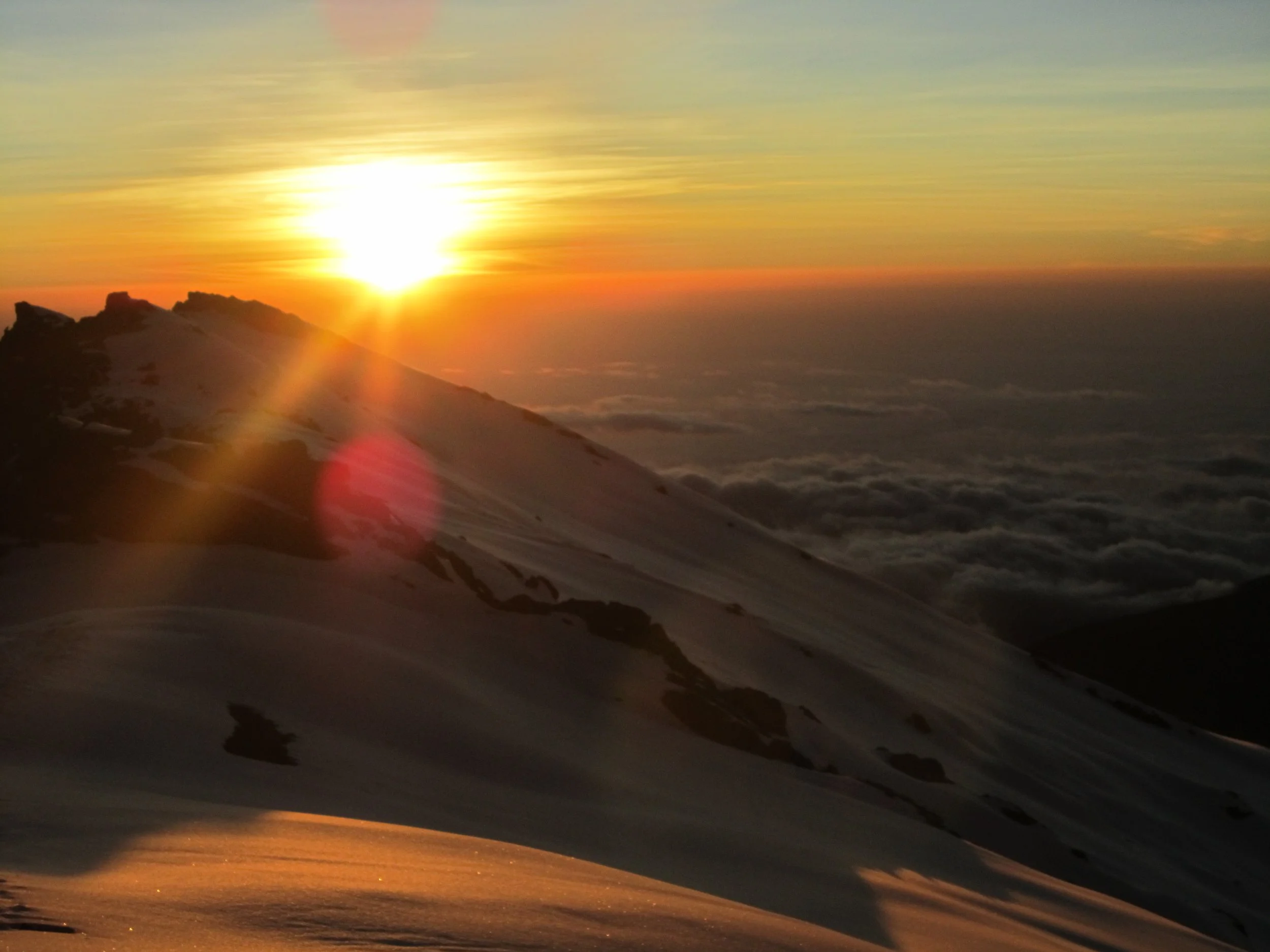
Wake around midnight and begin the summit push by headlamp, climbing steep scree switchbacks toward Stella Point on the crater rim — the hardest stretch of the entire climb. From Stella Point, a gentler hour along the rim leads to Uhuru Peak, the highest point in Africa, typically reached around sunrise. After time at the top, you'll descend all the way past Barafu to Mweka Camp, back in the moorland zone, for a well-earned night's rest.
Sunrise from Uhuru Peak · Kibo’s remaining glaciers
DAY 8
Mweka Camp → Mweka Gate → Hotel
DESCEND TO 1,640 M · 10 KM · 3-4 HOURS
A final, mostly gentle descent through thick forest to Mweka Gate, where you'll collect your summit certificate and say goodbye to your crew. Transfer back to your hotel in Moshi or Arusha for a hot shower and a proper bed — well-earned by this point.
Summit certificate ceremony at the gate
Booking the 7-day version removes Day 3 entirely — you'll trek from Mti Mkubwa directly to Shira 2 Camp in one longer day, skipping the overnight at Shira 1. We're glad to run it that way, but we'll generally recommend the 8th day first.
|
[ WHAT TO EXPECT ]
What’s actually different about this route
Camping throughout
Like Machame, Lemosho has no huts at any camp — you'll sleep in a two- or three-person mountain tent every night, with a separate dining tent for meals. We provide sturdy four-season tents and sleeping mats; a warm sleeping bag is essential and available to rent in Moshi or Arusha if you'd rather not travel with your own.
The remote, quiet start
The trailhead at Londorossi Gate is further from Moshi and Arusha than the other gates, meaning a longer drive on Day 1 — usually three to four hours. In exchange, the first two to three days cross genuinely remote terrain with far fewer climbers than the southern approaches, before rejoining the busier circuit at Barranco Camp.
Every Misele Kilimanjaro crew follows KPAP-aligned porter welfare standards. Read more about our crews and climbing standards on the Kilimanjaro overview page.
[ PRICING ]
Choose your trek length and comfort level
All prices are per-person estimates in USD and include the climb itself, park and hut fees, crew, and full board on the mountain. Camping equipment is the same across tiers — the difference is your pre- and post-climb hotel standard in Moshi or Arusha.
7-DAY CLIMB · STANDARD HOTEL
From (per person)
$2,500
6 persons traveling together___________________________
1 person $4,161
2 persons $3,172
4 persons $2,613
8-DAY CLIMB · SELECT HOTEL
From (per person)
$2,924
6 persons traveling together___________________________
1 person $4,755
2 persons $3,670
4 persons $3,048
8-DAY CLIMB · PREMIUM HOTEL
From (per person)
$3,065
6 persons traveling together___________________________
1 person $4,907
2 persons $3,807
4 persons $3,188
Inclusions & Exclusions
INCLUDED
Kilimanjaro National Park & camping fees
Certified lead guide, assistant guides, cook & porters
Four-season mountain tents & dining tent, all nights
Full board on the mountain (all meals)
Pre- and post-climb hotel night, per selected tier
Airport, gate, & Londorossi trailhead transfers
Emergency oxygen & first-aid kit carried by guides
Summit certificate
NOT INCLUDED
International flights
Tanzania entry visa
Travel & high altitude evacuation insurance (required)
Personal climbing gear & cold-weather clothing
Guide, cook & porter gratuities
Sleeping bag & trekking poles (rentable on request)
Prices vary by season and group size. Submit a request for exact figures reflecting your travel dates and group.
[ BEST TIME TO CLIMB ]
One mountain, two dry seasons
Kilimanjaro's weather windows don't change by route. Machame follows the same two dry seasons as all other paths up the mountain: January to mid-March, and June through October, the busier and more reliable of the two. Because Lemosho's early camps are already the quietest on the mountain, this route holds its peaceful character even during the busiest climbing months.
|
Traveling in a specific month? See our full Kilimanjaro seasonal guide for month-by-month conditions. Tell us your travel dates and we can advise honestly on what to expect.
[ FAQs ]
Lemosho Route FAQs
-
By most operator and park estimates, Lemosho's success rate runs around 90% on the 7-day itinerary and closer to 95% on the 8-day version — the highest figures of any Kilimanjaro route. The extra distance and days spent gaining altitude gradually are the direct cause; there's no shortcut version of this route that keeps the same odds.
-
Lemosho and Machame actually share the same final three to four days, including the same summit route via Stella Point. The difference is entirely in the approach: Lemosho spends two to three extra days crossing the Shira Plateau before reaching Barranco Camp, which gives climbers meaningfully more time to acclimatize before the altitude becomes serious.
-
We recommend the 8-day version to nearly everyone. The only difference is a single extra night on the Shira Plateau, which splits an otherwise longer walking day in two and gives your body more time to adjust at moderate altitude before the terrain steepens — a meaningful boost to your odds for a relatively modest added cost. The 7-day version remains available for climbers with a tighter schedule.
-
Not physically — the terrain and daily distances are similar once the two routes merge at Barranco Camp, and neither involves technical climbing. If anything, Lemosho is gentler in the early days, since the extra time on the Shira Plateau is spent at a more comfortable pace than Machame's steeper opening days. The main difference is logistics: a longer drive to the trailhead, and one or two extra days overall.
-
Layered clothing rated for temperatures from warm rainforest heat down to well below freezing on summit night, sturdy broken-in hiking boots, a warm four-season sleeping bag (rentable through us), trekking poles, headlamp, and good gloves. Because Lemosho is a camping route throughout with one extra night compared with Machame, a couple of spare base layers and a reliable sleeping mat are worth the extra weight. We send every confirmed climber a detailed packing list and can arrange rentals in Moshi or Arusha for anything you'd rather not fly with.
-
It's one of our most common requests, and the logistics work well — Kilimanjaro and the northern safari circuit share the same gateway towns. Most climbers build in two to three rest days after descending before heading into the Serengeti or Ngorongoro, and a short Zanzibar stay afterward is a popular way to end the trip entirely. Ask us about pairing this route with our Northern Highlights or Into the Wild itineraries.
-
Our Kilimanjaro crews follow KPAP-aligned welfare standards: fair daily wages, enforced weight limits on loads carried, proper cold-weather gear, and adequate food and shelter at every camp. This is a fixed part of how we operate, not an upgrade — it reflects the same low-impact, locally accountable approach we bring to our safaris.
Start planning your Kilimanjaro climb
No commitment. Have a real conversation with the Misele Team about which route fits you. We know Kilimanjaro routes extensively (we live here). We will reply within 24 hours.
Your details are never shared. We respond personally, usually within a few hours.
Other Routes with Misele
Marangu Route 5-6 Days
Machame Route 6-7 Days
Rongai Route 7 Days